Will fiction classification schemes increase use?

by Sharon L. Baker
RQ, Vol. 27, #3, Spring 1988, pp. 366-376.

Hypothesis 4 accepted: "Classifying fiction will increase the number of difference books that circulate because patrons will be exposed to less popular authors within a particular genre."

Experiment supporting hypothesis 4

Location:

  • Denton Public Library: 2,500 volumes
  • Thomasville Public Library: 6,000 volumes
  • Lexington Public Library: 15,500 volumes
Groups:
  • Experimental group 1: 100 romances shelved separately and marked with "romance" spine labels at Denton and Thomasville Libraries
  • Experimental group 2: 150 mysteries shelved separately and marked with "mystery" spine labels at Lexington Library
  • Experimental group 3: 150 romances marked with "romance" spine labels at Lexington Library. These 150 romances were on the regular shelves.
  • Control group: fiction located on regular shelves in all three libraries
Experiment:
  • Pre-test period: January 1986 to March 1986, circulation measured for all groups while on regular shelves.
  • Test period: April 1986 to June 1986, circulation measured for all groups in experimental condition and control group on regular shelves.
Results:

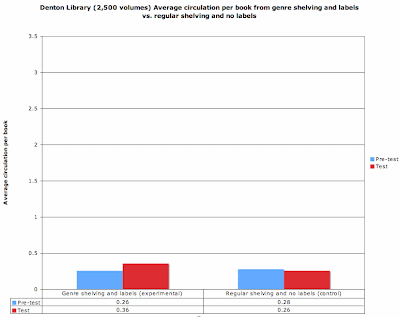
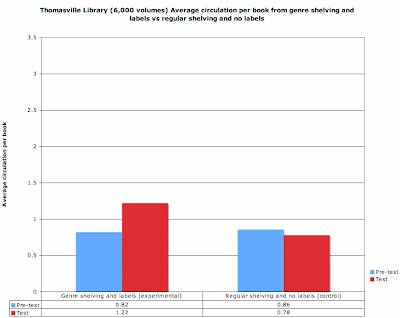
Genre shelving and labels had no effect on the percentage of titles circulating in Denton's 2,500 volume library. In the two larger libraries, however, genre shelving and labels dramatically increased the percentage of titles circulating. In the 6,000 volume library, almost 90% of the titles circulated.


Will fiction classification schemes increase use?

by Sharon L. Baker,
RQ Vol. 27, #3, Spring 1988, pp. 366-376.

Hypothesis 1 accepted: "Physically separating fiction into classed categories will significantly increase use, because browsers will be quickly and easily guided to the type of novel desired thus overcoming the effects of information overload."

Hypothesis 2 accepted: "Simply marking the spines of regular fiction titles with classed category labels (and leaving them interfiled with the regular fiction collection) will increase use, because browser will be quickly and easily guided to the type of novel desired thus overcoming the effects of information overload."

Hypothesis 3 accepted: "The overall use of classified fiction will increase directly with the library's size because browsers will use such classification schemes more as the potentioal for information overload increases."

Experiment supporting hypotheses 1, 2 and 3

Location:

  • Denton Public Library: 2,500 volumes
  • Thomasville Public Library: 6,000 volumes
  • Lexington Public Library: 15,500 volumes
Groups:
  • Experimental group 1: 100 romances shelved separately and marked with "romance" spine labels at Denton and Thomasville Libraries
  • Experimental group 2: 150 mysteries shelved separately and marked with "mystery" spine labels at Lexington Library
  • Experimental group 3: 150 romances marked with "romance" spine labels at Lexington Library. These 150 romances were on the regular shelves.
  • Control group: fiction located on regular shelves in all three libraries
Experiment:
  • Pre-test period: January 1986 to March 1986, circulation measured for all groups while on regular shelves.
  • Test period: April 1986 to June 1986, circulation measured for all groups in experimental condition and control group on regular shelves.
Results:

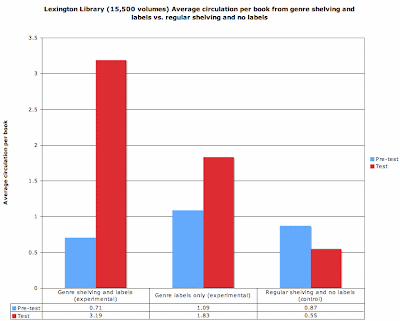
Hypothesis #1 evidence: Genre shelving and labeling increase circulation in all three libraries. Hypothesis #3 evidence: The amount of increased circulation depended greatly on the size of library.
  • In Denton Library with only 2,500 volumes, circulation increased only 38%.
  • In Thomasville Library with 6,000 volumes, circulation increased 49%.
  • Lexington Library, 15,500 volumes, increased 349%.
Hypothesis #2 evidence: The Lexington Library graph, middle section, clearly shows that merely genre spine labels also increases circulation. The increase of 68% is much less than separate genre shelving.


Hypothesis #3 evidence: An increasing percentage of patrons use genre shelving to overcome information overload as library size increases.
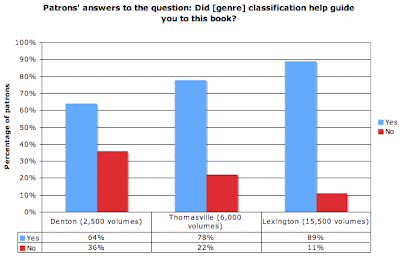


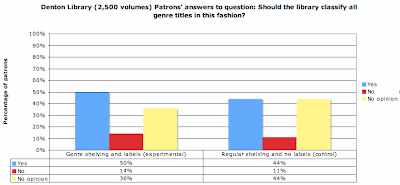
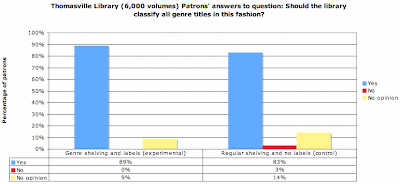
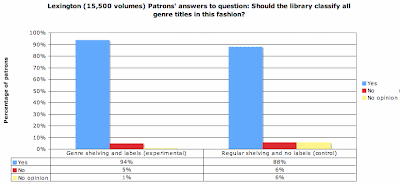
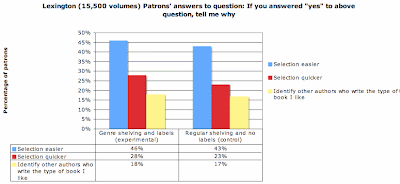
Hypothesis #3 evidence: As library size increases, patrons' desire for genre shelving and labeling increases from 50% in Denton's 2,500 volume library to over 90% in the larger libraries. Even patrons selecting books from regular shelves overwhelmingly wanted genre shelving.


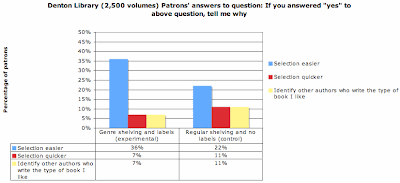
Hypothesis #3 evidence: Patrons want genre shelving because selection is easier, quicker and helps identify new authors writing the books they like.



Genre Fiction Classification: A study of the Durham County Library

by Amy J. Richard
A Master's paper for the M.S. in L.S. Degree, July 1999.
Web location

This 40-page paper explores how separating fiction in genre categories effected the library patrons of Durham County (North Carolina) Library.

From January 15-18, 1999, library staff reshelved fiction by genre and added genre spine labels and genre subject headings to the catalog.

Amy Richard's findings supported the first two of three hypothesis.

  1. "A majority of library fiction users browse the fiction collection and employ informal methods of selection."
  2. "A majority of the library fiction users feel the separation of the fiction collection is an improvement on the previous author alphabetical fiction classification scheme."
  3. "Circulation statistics will increase following the separation of the fiction collection into subject or genre categories."
Forty-six library users leaving the fiction area were interviewed about their selection habits.

Hypothesis #1


Thirty-nine (85%) claimed they did browse when looking for books, but the break out for actually selecting books is the following. They claimed to select books the following way.
  • Author's name = 48%
  • Browsing = 41%
  • Library catalog = 37%
  • Advice of a librarian or friends = 24%
  • Displays = 15%
  • Genre = 13%
  • Other = 13%
  • Reviews = 2%
Hypothesis #2

Thirty-two (69%) claimed separation of fiction into genre was an improvement, but this is not reflected in fiction circulation.

Hypothesis #3

The fiction was moved in mid-January 1999. Fiction circulation from February 1999 to April 1999 fell 42% to 48% from the same months of the previous year. Ms. Richards reasonably speculates that the rearrangement confused long-time patrons.

My observations

I think Ms. Richards is right. Forty-eight percent of library users claimed to select books by author and only 13% by genre. Rearranging fiction from author's names to genre may have,
in the short run, confused almost half of fiction readers. Unfortunately, the circulation statistics do not continue long enough to show recovery.

This experience suggests that readers may need finding aids to reorient them to the new locations of their favorite books.

Fiction Classification: A brief review of the research

by Gay W. Shepherd and Sharon L. Baker
Public Libraries Vol. 126, No. 1, Spring 1987, pp. 31-32.

This two-page article summarizes the findings of seven studies on fiction classification. "Fiction classification" is dividing fiction into genres (e.g., mysteries, westerns, romances, etc.) Implementing fiction classification can be done a number of ways.

  • Genre subject headings in catalogs
  • Genre spine labels
  • Shelving genre separately
  • Some combination of the above
The introduction summarizes Gail Harrell's 1984 survey on the way 49 US public libraries are currently classifying fiction. 26 libraries (53%) were combining distinct shelving, spine labels, and notation in the catalogs. The three most popular categories were science fiction, westerns and mysteries.

Four studies suggest classifying fiction may increase circulation of the fiction classified. In 1909, William Borden moved detective stories and historical fiction off the regular fiction shelves onto separate shelves. Patrons who had primarily only browsed the new books shelves began browsing, even preferring, this two sections. In two 1980s studies, 69% to 88% of patrons claimed fiction classification made finding books easier.

Librarians have long debated whether fiction should be shelved separately by genre or whether titles should remain shelved alphabetically by author with spine labels indicating different genre. According to David Spiller's 1980 survey, 59% prefer separate shelving and 24% prefer author name shelving.