Do you find choosing fiction in the library easy or difficult?

Survey question in How Reader's Select Fiction by Lyn Sear and Barbara Jennings, Research & Development Report, No. 9, 1986.

Survey Question:

  • Talking in a general way, do you find choosing fiction in the library easy or difficult?

Those surveyed:
  • 135 borrowers

Time of survey:
  • October 1985

  • Weekdays and Saturdays
Location of surveys:
  • Strood Library: 17,000 volumes

  • Tunbridge Library: 23,900 volumes

  • Maidstone Library: 39,900 volumes

Survey results:
  • 12% of patrons claimed choosing fiction books is difficult.

  • 45 % of patrons claimed choosing books was sometimes easy and sometimes difficult.

  • 23% of patrons claimed choosing books is easy.

  • Reasons given why choosing books is difficult or "so-so" are in the following order:

    1. "the books I want are never on the shelves."

    2. "I don't know what to look for."

The Influence of sloping shelves on book circulation 2

by Ralph R. Shaw
The Library Quarterly
Vol. 8, No. 4, October 1938, pp. 480-490.

Hypothesis accepted: Sloping the lowest four shelves increases circulation from these shelves because the spines face upward and are easier to read.

Experiment supporting hypothesis

Location: Gary (Indiana) Public Library

Groups:

  • Experimental group: Section of seven shelves with lowest three shelves tilted upward 45 degrees, so spines face browsers. The lower shelves are also moved forward into the aisle closer to browsers.
  • Control group: Section of seven regular shelves, i.e., all shelves are horizontal.
Experiment:
  • Test period #1: Two-week measurement of daytime and nighttime circulation from each shelf for both experimental and control groups. One section was just inside the room entrance. The other section was 15' inside the room.
  • Test period #2: Two-week measurement of daytime and nighttime circulation from each shelf for both experimental and control groups. Location of regular shelves and tilted shelves are switched.
  • Measurement of reflected light from books on both types of shelves.
Results:
  • Tilting the shelves did not increase the amount of circulation from the section of shelving. However, it did increase the pattern of circulation from the shelves within the section.

  • Measurement of foot-candles of light reflected from the books on each shelf clearly shows that tilting the lowest three shelves dramatically increases the amount of light reflected from books on the lowest shelves.

  • Increasing the light reflecting from the books on the lowest shelves evened out circulation across all shelves. On the straight shelves, circulation from the bottom three shelves is much lower than from shelves 2, 3, and 4. When the shelves are tilted, circulation is almost even across all seven shelves.

  • In the evening, reflection of light from books on the straight shelves was extremely bad. Tilting the lowest shelves helped.

  • Despite the bad lighting of the lowest shelves, circulation from these shelves was surprisingly good. I found no explanation for this anomaly.

Will fiction classification schemes increase use?

by Sharon L. Baker,
RQ Vol. 27, #3, Spring 1988, pp. 366-376.

Hypothesis 1 accepted: "Physically separating fiction into classed categories will significantly increase use, because browsers will be quickly and easily guided to the type of novel desired thus overcoming the effects of information overload."

Hypothesis 2 accepted: "Simply marking the spines of regular fiction titles with classed category labels (and leaving them interfiled with the regular fiction collection) will increase use, because browser will be quickly and easily guided to the type of novel desired thus overcoming the effects of information overload."

Hypothesis 3 accepted: "The overall use of classified fiction will increase directly with the library's size because browsers will use such classification schemes more as the potentioal for information overload increases."

Experiment supporting hypotheses 1, 2 and 3

Location:

  • Denton Public Library: 2,500 volumes
  • Thomasville Public Library: 6,000 volumes
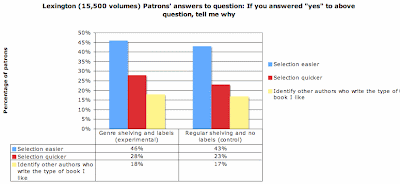
  • Lexington Public Library: 15,500 volumes
Groups:
  • Experimental group 1: 100 romances shelved separately and marked with "romance" spine labels at Denton and Thomasville Libraries
  • Experimental group 2: 150 mysteries shelved separately and marked with "mystery" spine labels at Lexington Library
  • Experimental group 3: 150 romances marked with "romance" spine labels at Lexington Library. These 150 romances were on the regular shelves.
  • Control group: fiction located on regular shelves in all three libraries
Experiment:
  • Pre-test period: January 1986 to March 1986, circulation measured for all groups while on regular shelves.
  • Test period: April 1986 to June 1986, circulation measured for all groups in experimental condition and control group on regular shelves.
Results:

Hypothesis #1 evidence: Genre shelving and labeling increase circulation in all three libraries. Hypothesis #3 evidence: The amount of increased circulation depended greatly on the size of library.
  • In Denton Library with only 2,500 volumes, circulation increased only 38%.
  • In Thomasville Library with 6,000 volumes, circulation increased 49%.
  • Lexington Library, 15,500 volumes, increased 349%.
Hypothesis #2 evidence: The Lexington Library graph, middle section, clearly shows that merely genre spine labels also increases circulation. The increase of 68% is much less than separate genre shelving.
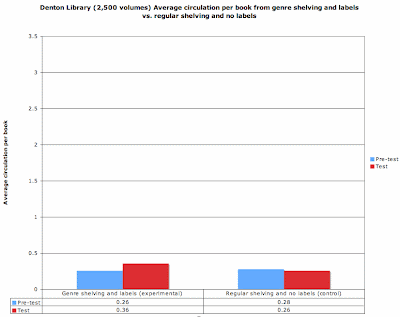
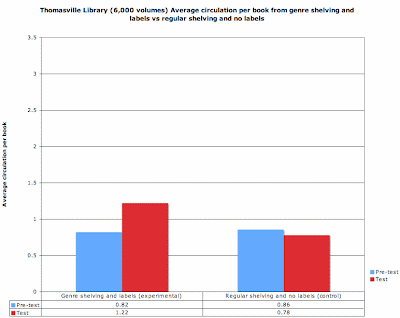
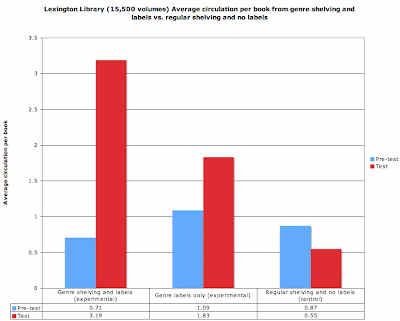


Hypothesis #3 evidence: An increasing percentage of patrons use genre shelving to overcome information overload as library size increases.
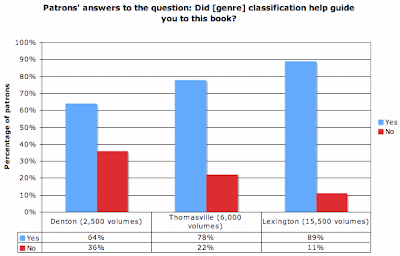


Hypothesis #3 evidence: As library size increases, patrons' desire for genre shelving and labeling increases from 50% in Denton's 2,500 volume library to over 90% in the larger libraries. Even patrons selecting books from regular shelves overwhelmingly wanted genre shelving.
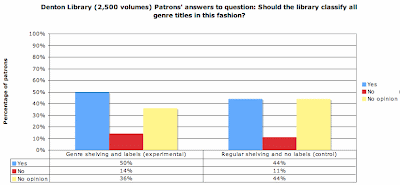
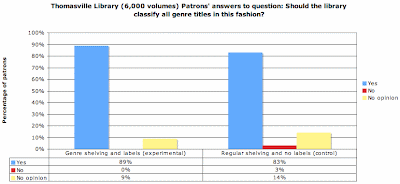
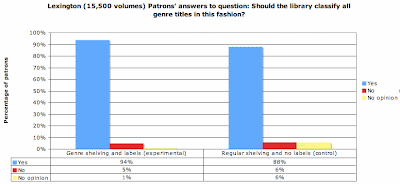


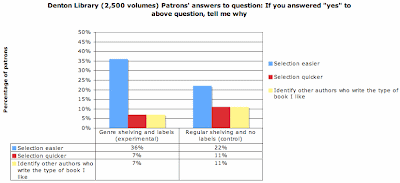
Hypothesis #3 evidence: Patrons want genre shelving because selection is easier, quicker and helps identify new authors writing the books they like.



The Effect of prime display location on public library circulation of selected adult titles

by Herbert Goldhor
The Library Quarterly
Vol. 42, # 4, October 1972, pp. 371-389.

Hypothesis accepted: "Adults borrow books from the public library primarily as a result of browsing and that which facilitates browsing will significantly increase circulation."

Experiment supporting hypothesis:

Location:

  • Champaign (Illinois) Public Library: 97,000 volumes
  • Urbana (Illinois) Free Library: 77,000 volumes
Groups:
  • Experimental group: 318 copies of 102 titles of fiction and non-fiction on display in a prime location in Champaign Public Library
  • Control group: 234 copies of 105 titles of fiction and non-fiction on regular shelves in Urbana Free Library
Experiment:
  • Pre-test period: November 1, 1969 to April 30, 1970, circulation measured for all groups while on regular shelves.
  • Test period: May 1, 1970 to October 31, 1970, circulation measured for all groups in experimental condition and control group on regular shelves.
Results:

Displays near the circulation desk increased the circulation of both fiction and non-fiction. Though fiction circulated three to four times more than non-fiction, displays increased circulation of fiction and non-fiction about the same percentage: 117% for fiction and 98% for non-fiction.


Displays of fiction, for women and non-students increase raw circulation numbers more than displays of non-fiction, men and students.

Though women circulated three to four times more books than men, displays increased circulation about the same percentage for women and men: 120% for women and 96% for men.


Displays increased non-student circulation by 223% and student circulation by a mere 49%.


There was no statistically significant difference between the libraries in the percentage of readers claiming to have read more than half or all of the book. Therefore, the ease of selecting displayed books does not reduce the actual use of the circulated books.


The Display phenomenon: An exploration into factors causing the increased circulation of displayed books

by Sharon L. Baker
The Library Quarterly
Vol. 56, #3, July 1986, pp 237-257.

Hypothesis 1 accepted: "Fiction books placed in a prime display location will circulate significantly more than their counterparts on the regular shelves or in a nonprime display location simply because they [i.e., prime location books] are more physically accessible and more visible to browsers."

Experiment supporting hypothesis 1
Location:

  • Mahomet (Illinois) Township Library: 10, 230 volumes
  • Monticello (Illinois) Township Library: 31,214 volumes
Groups:
  • Experimental group at prime location: 75 adult fiction books placed spine out on bookcart near circulation desk
  • Experimental group at nonprime location: 75 adult fiction books placed behind stacks at the back of the library
  • Control group: 75 adult fiction books remained on regular shelves.
Experiment:
  • Pre-test period: July 1, 1984 to September 30, 1984, circulation measured for all groups while on regular shelves.
  • Test period #1: October 1, 1984 to December 31, 1984, circulation measured for all groups in experimental condition and control group on regular shelves.
  • Test period #2: January 7, 1985 to April 6, 1985, books in prime and non-prime locations were reversed and then circulation was measured.
Results:

Sharon Baker notes that prime displays increased circulation of the books displayed, not the adult fiction collection as a whole.

In Mahomet Library with only 10,230 volumes, displaying books by the circulation desk increased their circulation 405% to 590%. Sharon Baker claims the prime display location circulated the most books because the books displayed at this location were "more physically accessible and more visible to browsers." This also supports the "principle of least effort" that people choose the most easily available resource even when better resources are available with a little more effort.


In Monticello Library with 31,214 volumes, displaying books by the circulation desk increase circulation even more, 784% and 708%. Circulation increase was largest in the largest library because, according to Sharon Baker in other articles, problems with information overload increase with library size.